
H4WIN Games: Pokies, Software Providers and Game Integrity
 Available in AU
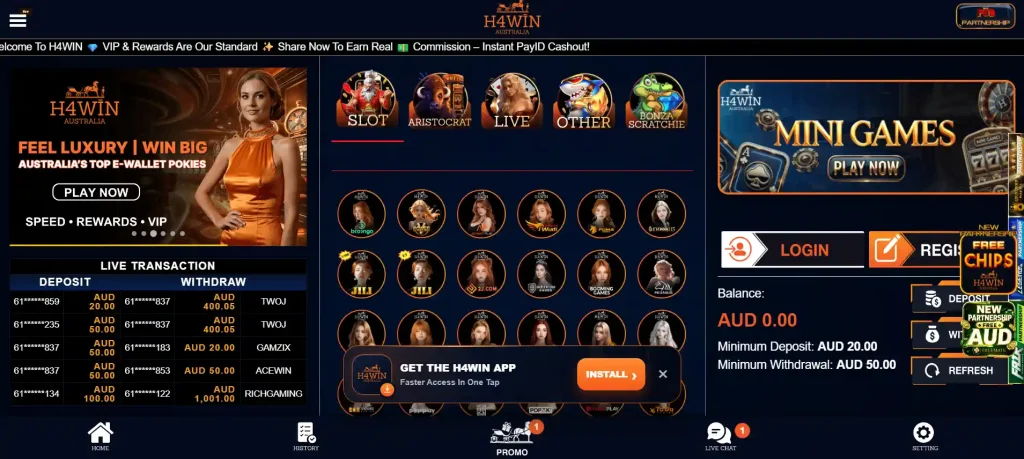
Pokies are the most recognisable part of the H4WIN AUS catalogue, but the game listing also spans table games, number games, crash formats, jackpots and scratch cards. Names appearing in the casino directories include Pragmatic Play, PG Soft, NetEnt, Play’n GO, Novomatic and several other software studios. Those listings describe a broad menu of game types; the more consequential questions concern the exact software behind each title and the way random results are generated.
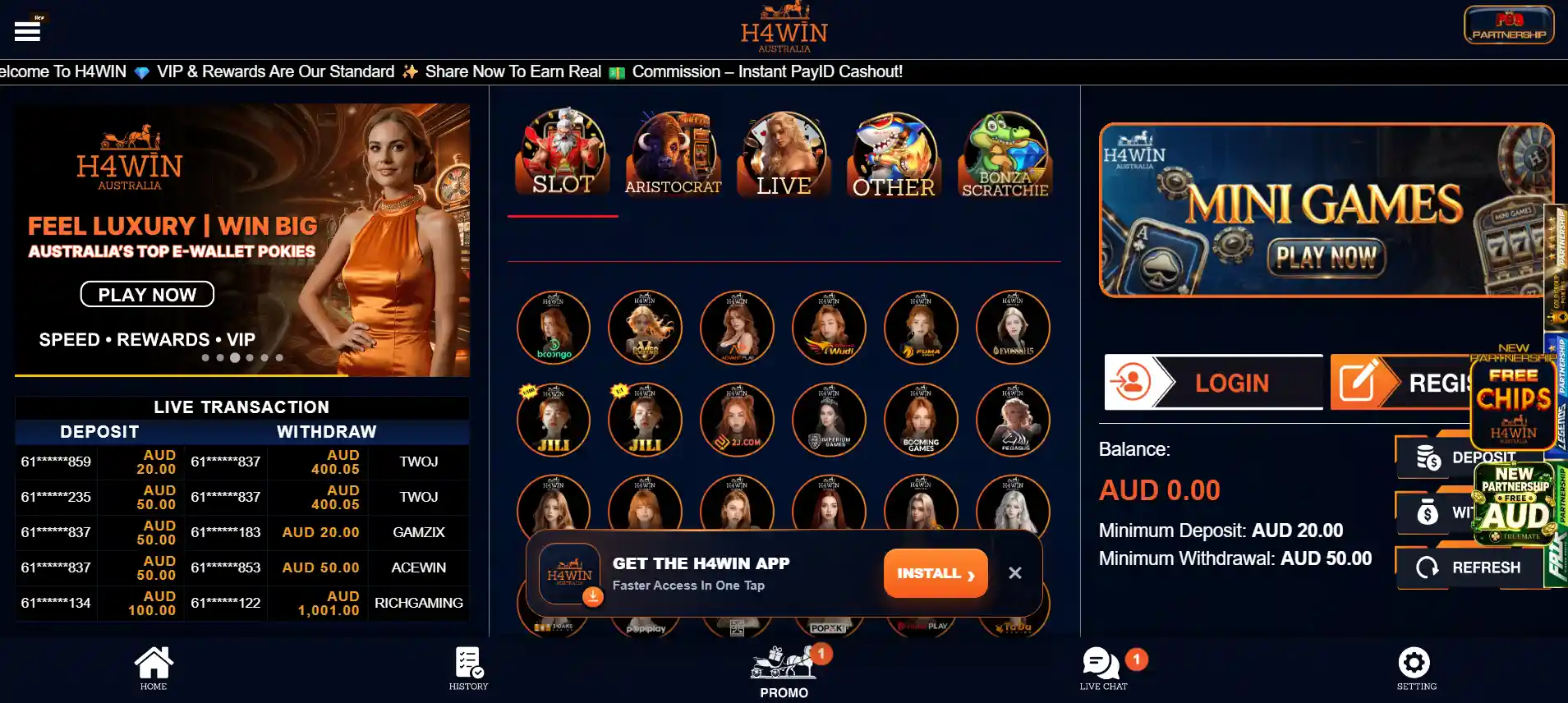
A game title, a studio logo and an attractive reel animation can give an impression of familiarity. None of those details alone explains the payout mathematics or proves that the software shown to a player is the studio’s authorised release. H4WIN AUS has attracted a specific game-integrity concern in an independent casino assessment. Understanding that concern is useful alongside the ordinary differences between pokies, card games and other chance-based formats.
Table of Contents
- Why familiar game artwork cannot establish software authenticity
- The H4WIN supplier list spans familiar studio names
- Named pokies show the variety of the catalogue
- Pokies, table games and number formats carry different risks
- Questions about the H4WIN AUS game catalogue
- H4WIN's varied catalogue makes title-level scrutiny essential
Why familiar game artwork cannot establish software authenticity
Casino Guru’s H4WIN AUS assessment raises concerns about suspected imitation games associated with more than one software supplier. It is a material consumer warning because a title presented under the name of an established studio may encourage assumptions about distribution, game mathematics and the rules of the original release. The allegation does not, by itself, show that every title in the catalogue is an imitation or establish misconduct in each game session.
The key distinction is between a catalogue label and the actual software instance. A listing can display the same game name, artwork or provider badge across different sites. The playable implementation determines how each spin or hand behaves, what help screens say and which return model is applied. The visible title is therefore only one element of the game’s identity. A general provider list cannot authenticate a specific session or establish that a publisher supplied every version directly.
Evidence that addresses different parts of the question
- Publisher and distribution records. Information from a software publisher can establish which original title belongs to that studio. It does not automatically connect the publisher to every website carrying the title.
- Game identification. A title, build or version reference can distinguish similar-looking products. Artwork alone is too easy to reproduce to serve that function.
- Rules and mathematical settings. Game-help information may describe paytables, volatility or a return percentage for a particular version. Those parameters matter separately from the visual appearance of the reels.
- Actual session records. Result history, stake, game title and timestamps can show what happened in a particular session, although the record alone does not prove how the underlying random generator operated.
These layers answer different questions. Authenticity concerns deal with where software came from; game mathematics deals with how it is designed to produce results; dispute records deal with what an account actually experienced. Conflating them can make a familiar brand name seem like a blanket guarantee of game behaviour. Even authentic software is built around random outcomes and a house advantage in the long run.
The identity issue also helps explain why a large supplier count should be read as a directory description, not as a quality score. A long list can provide variety, but variety does not resolve individual game-version questions. The H4WIN AUS overview discusses consumer reports alongside payment and account information; the game catalogue deserves its own scrutiny because that is where the chance-based product is actually experienced.
The H4WIN supplier list spans familiar studio names
Casino Guru’s H4WIN AUS profile lists 77 software suppliers. The count describes suppliers associated with the listing, not the number of distinct games accessible in any particular account. A supplier can contribute many games, a single game or only catalogue metadata. Counting names tells a different story from counting unique titles, and neither total measures the integrity of a particular game.
The names in the listing cover large international publishers as well as suppliers associated with particular slot styles and regional audiences. Each named publisher is associated with different styles of slot design, paytable structures and bonus features. These distinctions concern the titles themselves and do not establish which games are accessible in a particular H4WIN account.
| Directory-listed studios | Useful distinction | Reading the catalogue |
|---|---|---|
| Pragmatic Play, PG Soft, NetEnt, Play’n GO | Recognisable slot publishing names | Look at the specific title and its game rules, not only the studio badge. |
| Novomatic, IGT, Aristocrat, Amatic | Established game and gaming-equipment names | The presence of a name does not specify the exact software build. |
| Quickspin, Hacksaw Gaming, Wazdan, Habanero | Further slot-focused catalogue names | Individual games can differ materially in volatility and paytable design. |
| JILI | Another name in the H4WIN directory | A directory entry does not establish which games are active in each session. |
A useful comparison starts at the level of the game. Two products can both be called pokies while having different reel structures, bonus triggers, maximum-exposure profiles and ways of presenting wins. Conversely, two visually distinct games can share the same underlying principle: each outcome is generated according to a defined random or probabilistic system. Neither visual complexity nor the prominence of a studio name changes that basic proposition.
Why supplier breadth and game breadth are separate measures
There is also a difference between a directory entry and a title active for a particular visitor. A game library can change as content is added, retired or limited by account context. Older directory lists remain useful for identifying the product’s positioning, but they should not be interpreted as a promise that every listed title loads in every account. The practical value of the supplier list is to show the kinds of branded content associated with H4WIN AUS while keeping the precise game instance central to any technical assessment.
Payment systems are a different operational layer. The H4WIN payment reference explains how AUD banking methods and selected-account crypto assets differ. Those rails govern movement of funds; software providers govern game content. A transfer record cannot authenticate a game, just as a known game title cannot establish payment-processing reliability.
Named pokies show the variety of the catalogue
The H4WIN AUS directory includes Gates of Olympus, Sweet Bonanza, Book of Dead, Sugar Rush, Big Bass Bonanza and Wanted Dead or a Wild. These titles are useful anchors for understanding the familiar imagery and naming conventions of modern video pokies. The list establishes their appearance in a third-party catalogue; it does not specify the exact build or game configuration offered in an individual session.
Modern pokies are usually designed around repeated random outcomes and a paytable. Some use conventional paylines, others use cluster or symbol-collection mechanics, and many incorporate special events that are less frequent than ordinary reel results. A feature’s name can sound distinctive without altering the central financial fact that chance determines the result of each qualifying event. Animated sequences display those events; the graphics do not make the randomness predictable.
| Listed game | What to examine in its rules |
|---|---|
| Gates of Olympus | RTP setting, selected stake and rules for the version shown |
| Sweet Bonanza | Winning-combination rules and feature-trigger conditions |
| Book of Dead | Paytable entries, feature terms and stake-related returns |
| Sugar Rush | How features are triggered and how outcomes are valued |
| Big Bass Bonanza | Bonus-round conditions and rules for the displayed version |
| Wanted Dead or a Wild | Volatility and the distribution of winning outcomes |
It helps to separate several terms frequently placed next to a game name. Volatility describes the distribution of outcomes: one product might return small wins often, while another concentrates more of its mathematical return into rarer events. Return to player, usually abbreviated RTP, is a long-run statistical expectation specified for a game model. Maximum win describes a game rule or capped outcome when such a feature exists; it does not predict what a person will receive. These measures answer different questions and cannot replace one another.
A published RTP is also not a running meter that guarantees repayment. For example, if a hypothetical game had a 96% theoretical return, it would describe an average of A$96 returned per A$100 staked over a very large modelled sample, rather than a guarantee for any A$100 session. The 96% is an educational example and is not an H4WIN AUS game setting. Short sequences can contain substantial losses even when the long-run mathematical return is relatively high.
The relationship between an individual win and the full set of stakes is important. A screen can celebrate a return of more than the current stake while leaving the cumulative session negative. Likewise, a multiplier shown during one feature describes that feature, not the chance of entering it. Outcomes are best understood by considering total amounts risked, the complete payout record and the mathematical rules together, rather than a single impressive animation.
Named pokies may look familiar across different sites, but that familiarity does not resolve the authenticity question discussed above. The same distinction matters when examining terms attached to an account. The H4WIN account guide covers the identity and account rules described in the brand-associated material, which operate independently of whether a particular game has a recognisable title.
Pokies, table games and number formats carry different risks
H4WIN AUS is associated with a wider mix than reel-based pokies alone. Roulette, blackjack, baccarat and video poker fall into the table or card-game family. Bingo and keno use number-drawing conventions. Crash titles, jackpots and scratch-card formats add other ways to present random outcomes. The categories are meaningful because they change how results appear, how rapidly decisions repeat and what information a reader needs to interpret the game.
| Format in the H4WIN AUS listing | Typical mechanism | Main concept to understand |
|---|---|---|
| Pokies / slots | Random symbol combinations and defined paytable events | RTP, volatility and cumulative stakes |
| Roulette | Outcome determined by a numbered wheel or digital equivalent | Probability of a covered outcome and the payout schedule |
| Blackjack | Card totals and player decisions under stated rules | Rule variations and their effect on expected results |
| Baccarat | Card totals under a defined drawing procedure | Bet categories and payout differences |
| Video poker | Digital card draws and a paytable for hands | Paytable changes and decision-dependent outcomes |
| Bingo and keno | Matches against random number draws | Number of selections, prize tiers and draw mechanics |
| Crash games | Randomly ending multiplier-style rounds | Exposure to a round ending before a selected result |
| Jackpots and scratch cards | Special prize structures or instant-reveal outcomes | Event probability and total stake exposure |
Why table-game decisions do not remove the house advantage
Card and table games can involve decisions that influence the distribution of outcomes. In blackjack or video poker, the rules and choices can materially affect expected return; in baccarat, the permitted betting categories have different mathematical properties. These are generic differences between game families. They say nothing about the exact rules, table limits or implementations inside a particular H4WIN account. Skill-related decisions should never be treated as a promise of a positive financial result.
Roulette illustrates another distinction: the odds are determined by the possible outcomes and the payment for a selected bet. A streak of recent results does not cause a later result to be “due” on a fair independent wheel. The same error appears in pokies when players infer that a bonus must be close after a long sequence without one. The correct unit of analysis is the rule-defined probability of an outcome, not the story suggested by the last few animations.
Round speed and repeated exposure
Fast, short rounds can make losses accumulate before a person notices the total amount risked. If a hypothetical session consists of 100 rounds at A$1 each, the sum staked is A$100 before accounting for returned winnings. That arithmetic describes turnover, not a prediction of net loss and not an H4WIN minimum bet. A repeated stake can also be funded by previous returns, which means turnover can exceed the amount initially brought into a session. Distinguishing those two figures helps explain why a session may feel less expensive than its cumulative stakes suggest.
- Identify the format. A reel spin, card hand and number draw have different mechanics, even when they share a screen layout.
- Read the rule structure. The paytable, eligible outcomes and feature conditions determine how a theoretical return is constructed.
- Keep stakes separate from winnings. A large single result does not settle the balance of a longer session.
- Account for repeated decisions. Faster rounds create more opportunities to risk money within the same period.
Jackpots require particular care with terminology. A jackpot can refer to a prize feature within a title or a separately accumulated prize pool. Its advertised size does not state the probability of winning it. Scratch-card and number games have their own prize schedules and draw structures, so broad terms such as “instant game” or “jackpot” do not substitute for a mathematical explanation of an individual product.
Game availability can also depend on the version and presentation of a catalogue. The listed categories help describe the intended range of H4WIN AUS, while any claim about a specific playable software instance requires narrower evidence. The meaningful consumer questions remain consistent across formats: what is being risked, which outcomes can occur, how those outcomes are valued and how reliable the identification of the underlying game is.
Questions about the H4WIN AUS game catalogue
What kinds of games are associated with H4WIN AUS?
The H4WIN AUS directory includes pokies, roulette, blackjack, video poker, baccarat, bingo, keno, crash games, jackpots and scratch cards.
Which software studios appear in the H4WIN AUS catalogue?
The catalogue lists Pragmatic Play, PG Soft, NetEnt, Play’n GO, Novomatic, IGT, Quickspin and Hacksaw Gaming.
Which named pokies appear in the H4WIN AUS listings?
The listings include Gates of Olympus, Sweet Bonanza, Book of Dead, Sugar Rush, Big Bass Bonanza and Wanted Dead or a Wild.
How should a game-integrity concern be understood?
An integrity concern about titles associated with multiple suppliers applies to particular suspected game instances; it does not establish that every listed game is an imitation.
H4WIN’s varied catalogue makes title-level scrutiny essential
H4WIN AUS is associated with familiar pokies titles, a directory listing of 77 suppliers and a mix of table, number and instant-result game formats. The breadth is part of its identity, but the exact rules and software behind a title matter more than the length of the menu. An independent authenticity concern adds weight to that distinction without proving an outcome for every game. RTP, volatility and round speed explain different dimensions of gambling exposure; none can convert random results into a predictable income source.
For related context, the payments overview covers banking and crypto mechanics, while the account reference explains verification and account restrictions. Gambling can cause financial harm and debt; the full cost of a session includes repeated stakes, not only the starting balance.